
Experts Call for Stronger Exchange Rate Risk Management Round Table | 10 July 2026
“India must sustain growth of around 7.5–8% to strengthen its global relevance and achieve its economic potential,” says Prof. Ananth Narayan
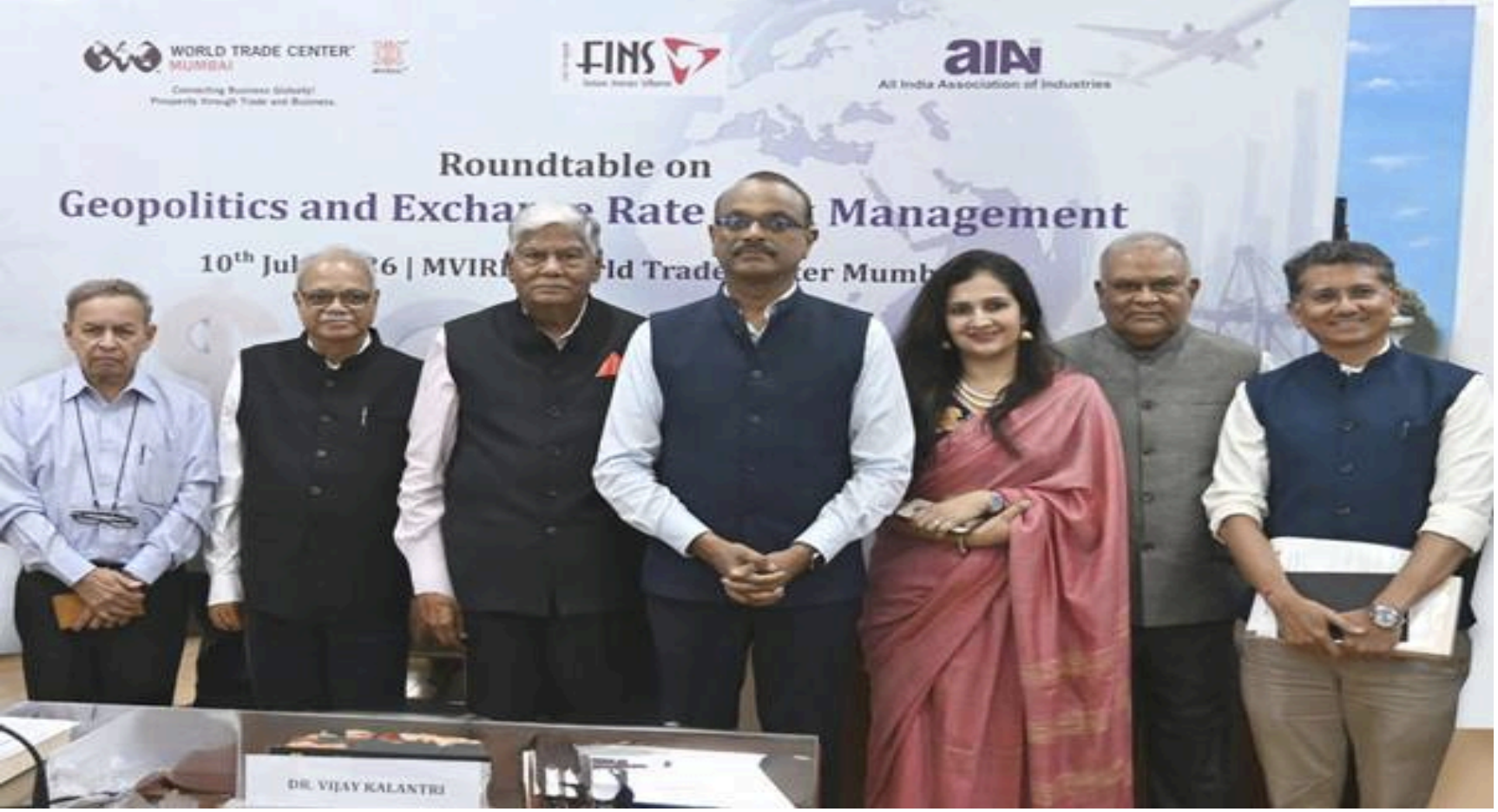
Mr. Satish Marathe; Adv. Bal Desai, Secretary General, Forum for Integrated National Security (FINS); Dr. Vijay Kalantri, President, All India Association of Industries and Chairman, World Trade Center Mumbai; Prof. Ananth Narayan, Former Whole-Time Director of SEBI and Financial Market Expert; Ms. Priya Pansare, Director, Trade and Investment Promotion; Prof. Sathianarayana Murthy, Former Banker and Forex, Treasury & Risk Management Professional; Mr. Maulik R. Shah, Co-Founder & CEO, Almus Risk Consulting, at the session
The traditional rules-based global order is changing rapidly, making economic strength, self-reliance and strategic preparedness increasingly important. India has a unique opportunity to position itself as a trusted manufacturing, investment and supply-chain partner as global trade and investment patterns undergo significant realignment, said, Prof. Ananth Narayan, Former Whole-Time Director of SEBI and Financial Market Expert, at Round Table Discussion & Deliberation on “Geopolitics and Exchange Rate Risk Management” organised by the All India Association of Industries (AIAI). and MVIRDC World Trade Center Mumbai, in association with the Forum for Integrated National Security (FINS).
“India must sustain growth of around 7.5–8% to strengthen its global relevance and achieve its economic potential. With substantial global liquidity available, India must communicate a strong and credible growth story to attract a greater share of international capital. As interest rates, equity valuations, foreign investment, capital flows and exchange rates are closely interconnected, exporters, importers and companies with foreign currency exposure should make prudent hedging and exchange-rate risk management an integral part of their business strategy,” said Prof. Ananth.
Dr. Vijay Kalantri, President, All India Association of Industries and Chairman, World Trade Center Mumbai said, “India’s strong foreign exchange reserves of around USD 667 billion as of late June 2026 provide an important cushion against external volatility. At the same time, merchandise and services exports crossing USD 860 billion in FY 2025–26 reflect the growing strength and global integration of India’s trade sector. To build on this momentum, India must sustain GDP growth of around 7–8% and strengthen its economic resilience and competitiveness. For businesses, however, exchange-rate and geopolitical volatility can translate into higher import costs, pressure on export margins where contracts are not adequately hedged, increased freight and insurance expenses, fluctuations in foreign currency loans, and greater uncertainty in pricing and working capital planning.”
Adv. Bal Desai, Secretary General, Forum for Integrated National Security (FINS), said, “For India, one of the world’s fastest-growing economies, exchange-rate movements have far-reaching implications for trade competitiveness, inflation, energy imports, foreign investment and overall macroeconomic stability. While currency values were traditionally driven largely by inflation, trade balances and capital flows, the global financial landscape has changed significantly. Today, geopolitical tensions, economic sanctions and disruptions to global supply chains can exert a major influence on exchange rates. Geopolitical risk assessment, therefore, is no longer confined to diplomats and strategic experts; it has become equally important for central banks, exporters, importers, treasury managers, financial institutions and investors.”
Further discussions were moderated by Dr. Nitin S. Kulkarni, Senior Fellow, FINS and Associate Professor, MET’s Institute of Management and featured Mr. Maulik R. Shah, Co-Founder & CEO, Almus Risk Consulting, and Prof. Sathianarayana Murthy, Former Banker and Forex, Treasury & Risk Management Professional. The discussions examined how geopolitical shocks influence rupee depreciation, India’s foreign exchange reserves, import-export performance and the Real Effective Exchange Rate, while also assessing volatility through India’s Volatility Index and Extreme Value Theory.
Mr. Maulik R. Shah, Co-Founder & CEO, Almus Risk Consulting, said, “India has made steady economic progress, but it must accelerate manufacturing, exports and trade competitiveness to fully benefit from the changing global economic landscape. In an increasingly volatile environment, businesses must prepare proactively for uncertainty rather than react after risks emerge. Fluctuations in foreign exchange rates, commodity prices and interest rates can significantly affect profitability, making financial risk management a strategic necessity.”
Prof. Sathianarayana Murthy, Former Banker and Forex, Treasury & Risk Management Professional, said, “Currency volatility is a natural feature of an open economy and should be viewed in perspective rather than with undue concern. Despite geopolitical uncertainty, India’s macroeconomic fundamentals remain strong, supported by healthy foreign exchange reserves, a stable current account position and prudent monetary management by the Reserve Bank of India. The present geopolitical and currency pressures are ‘passing clouds’, as India has successfully navigated similar challenges in the past. The country’s strong fundamentals and adequate reserves provide confidence in its ability to withstand current pressures and maintain long-term stability.”
The programme concluded with an interactive question-and-answer session, during which participants discussed practical approaches to managing foreign exchange exposure, treasury operations, commodity price risks and corporate hedging strategies.
In his concluding remarks, Mr. Satish Marathe said, “This discussion is timely, as India is poised to maintain a strong growth trajectory over the next decade. The country must ensure that this growth is broad-based and helps reduce income disparities across all segments of the economy. With manufacturing capacity utilisation exceeding 70%, rising global confidence and sustained investment inflows, India is increasingly emerging as a preferred manufacturing destination for major companies. The depreciation of the rupee should not be viewed as a sign of economic weakness, as India’s macroeconomic fundamentals remain strong and the country is well positioned to attract significant capital in the years ahead.”
Dr. Nitin S. Kulkarni delivered the vote of thanks, acknowledging the valuable contributions of the keynote speaker, panellists, dignitaries and participants. The roundtable concluded with a consensus that geopolitical risk management and exchange-rate preparedness must become integral to corporate strategy, enabling Indian businesses to navigate global uncertainties while strengthening their international competitiveness. Through such knowledge-driven dialogues, All India Association of Industries and World Trade Center Mumbai continues to foster informed policy discussions and equip businesses with the insights needed to thrive in an increasingly dynamic global trade environment.
Regards,
Sangeeta Jain
Senior Director
All India Association of Industries (AIAI)