
INFRASTRUCTURE AND CONNECTIVITY AS GROWTH ENGINE: AIAI and WTC MUMBAI CHARTS PATH FOR ECONOMIC DEVELOPMENT AT THE 10TH GLOBAL ECONOMIC SUMMIT
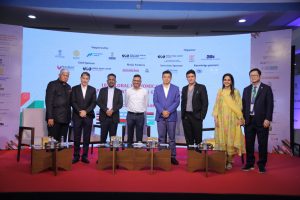
From Left to right: Mr. Vijay Kalantri, President, All India Association of Industries (AIAI) and Chairman, World Trade Centre, Mumbai; Mr. Bhushan Gagrani, Municipal Commissioner, Brihanmumbai Municipal Corporation; Mr. P Anbalagan, Industries Secretary, Government of Maharashtra; Mr. Varun Singh, Editor, SquareFeat India; Mr. Sanjay Mukherjee, Metropolitan Commissioner, MMRDA; Mr. Ashish Raheja, Chairman, Raheja Universal; Ms. Sangeeta Jain, Senior Director, All India Association of Industries and Mr. Scott Wang, WTCA Vice President at the Infrastructure and Connectivity Panel – 10th Global Economic Summit
MUMBAI — A distinguished panel of senior government officials and leading infrastructure developers convened at the 10th Global Economic Summit to deliberate on the transformative role of infrastructure in accelerating economic development across Mumbai and the Mumbai Metropolitan Region (MMR). The discussion underscored how strategic infrastructure investment, integrated urban planning, and robust public-private partnerships are essential catalysts for achieving sustained economic growth and enhancing regional competitiveness in an increasingly interconnected global economy.
Speaking on the occasion Mr. Bhushan Gagrani, Municipal Commissioner of Brihanmumbai Municipal Corporation said, “The transformation of Mumbai is driven by conscious efforts, strategic financial resource allocation, and coordinated planning between public authorities and private sector stakeholders. This is evident from the large construction projects which we have undertaken over the previous years. Infrastructure projects like Coastal Road and Sea Link connecting the Mumbai City with the suburban Bandra , Trans harbour link connecting Navi Mumbai with the Mumbai city and expansion of metro which is projected over 150+ km by 2030 has not only enhanced urban mobility but also led to sustainable development of the region. Government aims to achieve the target of 59 minutes which essentially means that a person should reach from point A to point B in less than an hour. This connectivity projects have enabled ease of travel thereby boosting connectivity. Over the next 2-3 years, critical infrastructure projects—including housing developments, sewage treatment plants (STPs), tunnels, connectors, and metro expansion—are expected to significantly improve the living standards as per international benchmarks. As the city expands by 500-700 hectares annually, the government is simultaneously investing in sustainable infrastructure to support this growth without compromising livability.”.
Mr. Gagrani further highlighted that the unique challenges posed by Mumbai’s geography, as it is an island city with 50% reclaimed land and a linear urban structure, makes traditional concepts of self-sustainable townships with walk-to-work accessibility practically difficult. However, planning authorities have consistently worked to overcome these constraints. He emphasized that meaningful solutions require two key pillars: the development of a robust Mass Rapid Transport (MRT) system and the expansion of affordable housing. These initiatives, coupled with strategic infrastructure development in the MMR periphery, can create affordability and accessibility across the metropolitan region.
While speaking on affordable housing, Mr. Gagrani said,” Better infrastructure will bring connectivity and thereby equilibrium into the real estate market. This will create affordable housing a reality”. Outlining the Mumbai Metropolitan Region Development Authority (MMRDA) vision, Mr. Sanjay Mukherjee, Metropolitan Commissioner, MMRDA stated, “The MMRDA authority operates under four guiding principles: Rebooting the City, Reshaping the MMR, Redesigning travel patterns and Reimagining the city’s future”. Mr. Mukherjee further said that these principles are translating into tangible outcomes, particularly through the expansion of the metro network—positioning Mumbai as India’s thirdlargest urban metro system.
While outlining the future of the agency Mr. Mukherjee said, “This year we have allocated a budgetary outlay of over 40,000 crores for development of MMR. Current MMRDA initiatives include the development of industrial townships and residential complexes at strategic locations such as BKC (Bandra-Kurla Complex) and Wadala. Connectivity has become a tool to address the walk-to-work objective. We advocate for a hybrid infrastructure system that integrates multiple transit modes and land-use strategies to create liveable, connected communities. The population of MMR officially is at 3.16 crores and population of Canada is 3.6 crores being a country. However, the resource constraints, land availability, spatial distribution, capital allocation, and wealth distribution are fundamentally different. In MMR, we operate within severe geographic and fiscal constraints, requiring locally tailored, context-specific solutions rather than conventional urban planning models.
Mr. Mukherjee further said, “The path forward demands us innovative domestic solutions that leverage our strengths while addressing our distinctive challenges. For every rupee which we invest in infrastructure, it has multiplier effect and will yield us 2.5 Rs. in return showing us that investment in infrastructure brings immense benefits to the economy”. “With Maharashtra’s economy valued at $552 billion and Mumbai’s contribution reaching $134-150 billion, achieving the state’s $1 trillion economic target by 2030 requires Mumbai’s economy to grow at an accelerated CAGR of 12-14%. This is being powered by state’s forward looking and business friendly Industrial Policy and single window clearance system which aims to remove business constraints and improve business climate”, said Mr. P Anbalagan, Industries Secretary, Government of Maharashtra while identifying the MMR as the primary growth engine for this ambition.
“Realizing this vision demands a total investment of $850 billion through 2030. These investments can be catalysed by emerging economic sectors, including the creative economy, FMCG, media and entertainment, Global Capability Centers (GCC), and data centres sectors that are already driving competitive advantages in the region. Maharashtra currently accounts for 8.9 million MSMEs, of which over 6.5 million MSME’s have been formalized, with expectations to reach the 10 million mark within the next couple of years. With 30% of India’s startups located in Mumbai, coupled with worldclass infrastructure development, the city is uniquely positioned to capture these growth opportunities and attract quality investments,” Mr. Anbalagan explained.
Mr. Ashish Raheja, Chairman, Raheja Universal, drew attention to the paradox of developing infrastructure in a continuously growing city—likening it to performing complex surgery on a fully active patient without anaesthesia. “Despite these challenges, the last decade has witnessed incremental infrastructure improvements that have yielded exponential benefits for residents and businesses,” he stated. Recognizing that Mumbai comprises 20 distinct micro-cities, Mr. Raheja emphasized the need for integrated clustering strategies to optimize resource allocation and urban cohesion. He also addressed the affordable housing challenge, noting that free-market economics alone cannot address the supply deficit. The solution lies in connectivity-driven development: targeted infrastructure investments that transform peripheral areas into aspirational destinations, thereby promoting sustainable urban growth and equitable development across the metropolitan region.
Ms. Sangeeta Jain, Senior Director, All India Association of Industries (AIAI), in her remarks stressed on the sustainable development of infrastructure. “Given India’s vast potential on renewable energy, we should target integrating green energy projects like Green Hydrogen, Green Ammonia along with infra projects to sustain our commitment towards environment. The recent expansion of aqua line is a classic example of how Infrastructure development helps in dealing with environmental issues, as the metro will displace lakhs of cars running on road thereby offsetting carbon emissions”
Ms. Priya Pansare, Director, Trade and Investment Promotion, World Trade Centre, Mumbai while thanking the panellists for their insights on the critical role which Infrastructure and connectivity plays in strengthening growth said, “The push and the priority given to the infrastructure development is paying us dividends. With multi- modal transport integration, the costs of logistics have come to 10% level which is further estimated to fall. Mumbai, being the commercial and financial capital of the country, should have world class infrastructure not only within the city but also for catering to the vast import and export market. This panel discussion came at an important juncture when we are focusing on developing our Manufacturing sector to be 25% of the GDP. The views and insights shared by the distinguished panellists will surely help to shape the discourse on infrastructure in times ahead”.
The panel discussion held at the 10th Global Economic Summit was moderated by Mr. Varun Singh, Editor, SqaureFeat India. It underscored that Mumbai’s infrastructure transformation requires sustained investment, coordinated governance, strategic connectivity initiatives, and alignment between public policy and private sector capabilities.
As the city navigates rapid urbanization, these integrated approaches will determine its ability to achieve economic ambitions while ensuring quality of life and sustainability for its residents.